
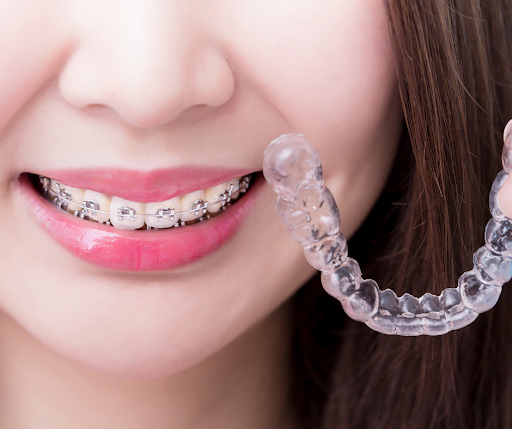
If you have decided to straighten your teeth, congratulations, that is a genuinely great decision for both your smile and your long term oral health. The next question is usually the hard one: should you go with braces or Invisalign? Both can give you a beautiful, healthy result, and there is no single right answer for everyone. The best choice depends on your case, your daily routine, and what matters most to you. Here is an honest comparison to help you walk into your consultation ready to choose with confidence.
How Each Option Works
Braces use small brackets bonded to your teeth and connected by a thin wire. At each visit, that wire is adjusted to gently guide your teeth into position. Because braces are fixed in place and working around the clock, they give your orthodontist precise control over even complicated movements.
Invisalign clear aligners take a different approach. Instead of brackets and wires, you wear a series of clear, custom made trays that move your teeth in small steps. You switch to a new set of aligners every week or two, and each tray is slightly different from the last, so your teeth shift gradually toward the final result.
Appearance
For many patients, this is the deciding factor. Invisalign aligners are clear and sit close against the teeth, so most people will not notice you are wearing them. If a nearly invisible look is a priority, that is a strong point in Invisalign’s favor.
That said, braces have come a long way too. Alongside dependable metal braces, clear braces use tooth colored brackets that blend in far better than the braces of the past. So even if you like the idea of a subtle look but are not a candidate for aligners, you still have a discreet option.
Comfort and Daily Life
Both options feel a little different at first as your teeth begin to move, which is completely normal and a sign that treatment is working. Aligners have no brackets or wires, so some patients find them smoother against the cheeks and lips.
The bigger lifestyle difference is removability. Because Invisalign trays come out, you can eat whatever you like and brush and floss normally, then pop the aligners back in. With traditional braces, you avoid certain hard and sticky foods and learn to clean carefully around the brackets. Neither is difficult, but they ask different things of you day to day.
Responsibility and Discipline
Here is the trade off that comes with removable aligners. Invisalign only works if you wear it, and that means keeping the trays in for around twenty two hours a day, taking them out only to eat and clean your teeth. For a disciplined teen or adult, that is no problem. For a younger patient or anyone who suspects the trays might end up in a backpack instead of in their mouth, braces remove the temptation entirely because they are never taken off. There is no wrong answer here, only an honest read on what fits the person.
Which Cases Suit Which Option?
Braces remain the most versatile choice and can handle the full range of cases, including complex bite corrections and significant crowding. Clear aligners are an excellent fit for mild to moderate cases and continue to handle more situations as the technology improves. The most reliable way to know which option suits your teeth is an exam with an orthodontist in Chattanooga who can evaluate your bite and your goals together.
What About Treatment Time?
Patients often assume one option is always faster than the other, but treatment time depends far more on your specific case than on which appliance you choose. A simple correction can be quick either way, and a complex one will take longer either way. Our overview of how long treatment takes walks through the typical range and what influences it.
Making the Decision
The good news is that you do not have to figure this out alone. During your consultation, Dr. Twomley will examine your teeth, talk through your priorities, and give you a straight recommendation about which option fits your case best. Both braces and Invisalign are proven, effective ways to get the smile you want, so whichever path is right for you, you are in good hands.
Frequently Asked Questions
Is Invisalign as effective as braces?
For the cases it is suited to, Invisalign is very effective. Braces remain the more versatile option for complex bite corrections and significant crowding. The best way to know which will work for your teeth is an exam with an orthodontist.
Are braces or Invisalign more comfortable?
Both feel a little different as your teeth start to move, which is normal. Some patients find aligners smoother because there are no brackets or wires, while others adjust to braces quickly. Comfort is fairly similar overall once you get used to treatment.
Which option is better for teenagers?
It depends on the teen. Invisalign works well for responsible patients who will keep the aligners in around twenty two hours a day. For a teen who might forget or misplace removable trays, braces can be the more dependable choice because they are always working.
Can I switch from braces to Invisalign during treatment?
In some cases a treatment plan can be adjusted, but this is a decision to make with your orthodontist based on how your teeth are responding. The best approach is to choose the right option at the start, which is what your consultation is for.
How do I decide between braces and Invisalign?
Start with a consultation. An orthodontist can examine your bite, factor in your lifestyle and your goals, and recommend the option that fits your case. Red Leaf Orthodontics offers a free consultation in Chattanooga to help you choose.