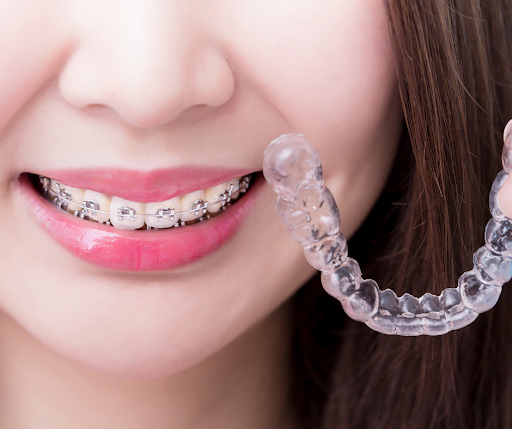

Clear Braces vs. Invisalign for Adults: Which Discreet Option Fits Your Life?
Straightening your teeth as an adult shouldn’t mean a mouth full of metal. When people compare clear braces vs. Invisalign for adults, the real question is which discreet option fits their work, family, and social calendar. Both straighten teeth beautifully. They just get there differently.

What Are Clear Braces and Invisalign?
Clear braces are tooth-colored brackets bonded to your teeth and connected by a thin archwire that works 24/7. Invisalign uses custom-made, removable clear trays you swap every one to two weeks. Both straighten adult smiles without the look of traditional metal braces.
Clear braces work the same way metal braces do. The difference is cosmetic: ceramic brackets blend with your natural enamel, and they’re often paired with clear, white, or tooth-colored wires and ties so they stay subtle in conversation and in photos.
Invisalign takes a modern approach. A digital scan becomes a 3D treatment plan, and each tray nudges your teeth closer to their final position. You take the trays out to eat, brush, and floss, then pop them back in.
One quick note on wording. “Clear braces” and “clear aligners” get mixed up constantly, even in online reviews. Clear braces stay bonded to your teeth. Aligners come out. Dr. Twomley walks adults through both at their free consultation so nobody chooses a treatment based on a misunderstood label.
How Each Treatment Moves Your Teeth
Clear braces move teeth with a bracket-and-archwire system that applies steady, continuous force, with adjustments typically every 6 to 10 weeks. Invisalign moves teeth through a sequence of custom trays, each one programmed for a small, precise amount of movement. Both rely on the same biology: gentle pressure remodels the bone around each root.
With clear braces, the process looks like this:
- Ceramic brackets are bonded to the front of each tooth.
- A shape-memory NiTi archwire is placed to deliver gentle, continuous force as it works back toward its original shape.
- You come in every 6 to 10 weeks for a wire change or adjustment.
- Elastics may be added to correct how your bite fits together.
With Invisalign, the process looks like this:
- We capture an easy breezy 3D scan of your teeth. No goopy trays.
- Dr. T maps out your customized treatment plan digitally, tooth by tooth.
- Small tooth-colored attachments may be bonded to certain teeth so the trays can grip and rotate them.
- You wear each tray 20 to 22 hours a day, then move to the next in the series.
- Elastics can be added for bite correction, just like with braces.
Adult timelines vary with the case. Many adults finish clear braces in roughly 12 to 24 months, while Invisalign cases often run about 6 to 18 months depending on complexity. The biggest variable with aligners isn’t the technology. It’s wear time. Trays sitting in a napkin at lunch don’t move teeth. Adults who build tray changes into a nightly routine tend to stay right on schedule.
Both approaches depend on the person planning them. Dr. Twomley, an orthodontic specialist, completed 10 years of training to become an orthodontist: four years of college, four years of dental school, and two additional years of specialty residency. Out of 100 dental school graduates, on average only six go on to become orthodontists. That’s the specialized expertise behind every customized treatment plan we build.
Benefits of Each Option for Adults
Both options deliver a discreet smile transformation. They just have different advantages.
Clear braces are a strong choice because they:
- Work around the clock with zero compliance required from you
- Handle complex rotations, deep bites, and large corrections predictably
- Stay put for adults who travel often, work long shifts, or know they’d forget to re-insert trays
- Are strong & sturdy, with a proven track record across decades of orthodontics
- Let Dr. T control tooth movement precisely with wire bends and elastics
Invisalign is a strong choice because it:
- Comes out for meals, coffee, brushing, and flossing
- Slips out again for wedding photos and big presentations
- Has no wires or brackets to irritate your cheeks and lips
- Rarely creates emergency visits. There’s nothing to break or poke.
- Makes oral hygiene simple. That matters for adults with existing gum concerns.
- Often means fewer in-office visits, with virtual check-ins between tray changes
For busy parents especially, the “no broken bracket at 8 p.m.” factor is real. That’s one reason Invisalign appeals to adults juggling work and kids’ schedules. Clear braces have their own version of that convenience, since there’s nothing to remember, pack, or replace.

Clear Braces vs. Invisalign for Adults: Side-by-Side Comparison
Here’s how the two options stack up on the factors adults ask about most.
| Factor | Clear Braces | Invisalign |
|---|---|---|
| Visibility | Subtle from a distance, noticeable up close | Nearly invisible in most lighting |
| Removability | Fixed to teeth for the full treatment | Removable for meals and cleaning |
| Typical adult timeline | Often 12 to 24 months | Often 6 to 18 months |
| Case complexity | Handles severe crowding, rotations, and big bite corrections | Best for mild to moderate cases; complex cases possible with attachments |
| Comfort | Some soreness after adjustments; possible wire or bracket irritation | Some tightness with each new tray; no wire irritation |
| Compliance needed | Minimal | High (20 to 22 hours daily) |
| Maintenance | Careful brushing around brackets; avoid hard and sticky foods | Clean trays daily; no food restrictions |
| Office visits | Every 6 to 10 weeks | Fewer visits for many adults, plus virtual options |
A few details worth understanding before you decide:
Staining
Ceramic brackets themselves resist staining well. The clear elastic ties that hold the wire can pick up color from coffee, red wine, curry, and tomato sauce. Those ties get replaced at every adjustment, so any discoloration is temporary. Aligners can cloud or pick up odor if they aren’t rinsed and cleaned daily.
Complexity
When teeth are severely crowded, badly rotated, or need extraction space closed, braces usually give Dr. Twomley the most direct control. Aligners have come a long way, and attachments plus elastics expand what they can do, but not every case is a match.
Lifestyle
If your week involves client dinners, video calls, or contact sports, removable trays fit that rhythm nicely. If your week involves travel, unpredictable hours, and a habit of losing things, brackets that stay put may serve you better. It really is about treatment that fits your life.
What Affects the Cost of Each Option
For most adults, clear braces and Invisalign land in a comparable price range. Cost is driven by how complex your case is, not by which brand name is on the box. Treatment length, the number of trays or wire changes required, and the diagnostics involved all shape the final number more than the appliance itself.
The main cost drivers:
| Factor | How It Affects Cost |
|---|---|
| Case complexity | More movement means more time, more trays, or more adjustments |
| Treatment length | Longer plans include more visits and monitoring |
| Refinements | Extra aligner sets to polish results can extend an Invisalign case |
| Diagnostics | A 3D scan and digital photographs shape your customized treatment plan |
| Retainers | Required after either treatment to hold your result |
Orthodontic insurance benefits typically apply to both options in the same way, since carriers cover orthodontic treatment rather than a specific appliance. FSA and HSA dollars usually apply as well. Our team will review your specific benefits with you at your free consultation, so you know what’s covered before you commit to anything.
Red Leaf Orthodontics is a family-owned, local orthodontics office built from the ground up by Dr. Tyler Twomley and his wife, Amanda, and we offer convenient payment options with monthly structures and flexible down payments. What you actually feel month to month can look very different from the total. Budget for retention, too. Retainers protect the investment you just made, and they’re part of the plan from day one.
Which Option Is Right for You?
Neither option wins across the board. The right one matches your bite, your health, and your daily habits.
Clear braces may be the better fit if you:
- Have significant crowding, spacing, or rotated teeth
- Need substantial bite correction or extraction space closed
- Aren’t confident you’d wear trays 20+ hours a day
- Want treatment that works without you thinking about it
Invisalign may be the better fit if you:
- Have mild to moderate crowding or spacing
- Experienced relapse after wearing braces as a teen
- Speak, present, or appear on camera regularly for work
- Prefer eating whatever you want with no bracket-related restrictions
Either way, healthy foundations come first. Gums should be free of active periodontal disease, cavities should be treated, and existing restorations should be stable before treatment starts.
Crowns, veneers, and implants add another wrinkle. Brackets bond differently to porcelain than to enamel, and implants don’t move, so they get planned around. Dr. T reviews all of it with you before anything gets bonded or scanned.
The honest answer is that records tell the story. A free consultation with digital photographs and a 3D scan shows exactly what your teeth need, and you’ll leave knowing which option makes sense and why.
Comparing options online only takes you so far. Seeing your own scan makes the choice a lot clearer. Adults are welcome to schedule a free consultation to compare clear braces and Invisalign side by side. You deserve a stunning smile, and we’d love to help you choose the option that fits your life.

Frequently Asked Questions
Do clear braces work as fast as Invisalign?
It depends entirely on the case, not the appliance. Simple alignment cases often move faster with Invisalign, while complex bite corrections and severe rotations are frequently more efficient with clear braces. Aligner timelines also assume near-full-time wear, so real-world results track closely with how consistently trays are worn.
Do ceramic clear braces stain?
The ceramic brackets themselves are highly stain-resistant. The clear elastic ties around each bracket are what can pick up color from coffee, tea, red wine, and richly colored foods. Those ties are swapped out at every adjustment visit, so any discoloration is short-lived and fully reversible.
Can adults get Invisalign if they had braces as a teen?
Yes, and this is one of the most common adult cases we see. Teeth shift over the years, especially when retainer wear stopped after treatment. Relapse cases often involve mild to moderate movement, which tends to be a good match for Invisalign and a shorter treatment time.
Which is more comfortable, clear braces or aligners?
Most adults report less irritation with Invisalign because there are no wires or brackets rubbing against the cheeks and lips. Both options cause some soreness when teeth start moving. With braces, that follows an adjustment. With aligners, it follows each new tray. The discomfort is normal and typically fades within a day or two.
Can you switch from Invisalign to clear braces mid-treatment?
Yes. If aligners aren’t achieving a particular movement, or if wear time hasn’t been consistent, Dr. Twomley can transition you to braces to finish the case. Some plans intentionally combine both. The goal is your result, not loyalty to one appliance.
Will I need a retainer after either treatment?
Yes, retainers are required after clear braces and after Invisalign. Teeth have memory and will drift back toward their old positions without retention. Dr. T will walk you through your retainer options and wear schedule as you finish treatment, and retention is built into your customized treatment plan from the start.